

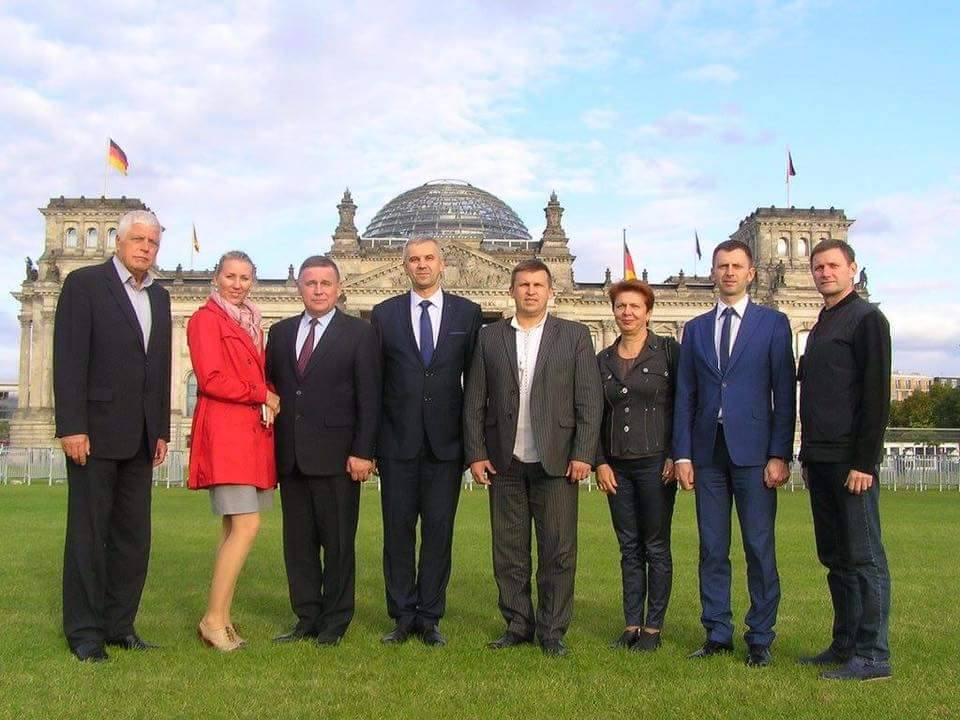
 Ukrainian delegation from Dnipropetrovsk and Volyn regions visited Germany in the framework of the program “Action Plan 2030” – sustainable development of the countries, which means without environmental deterioration.
The trip was organized by the Deutsche Gesellschaft für Internationale Zusammenarbeit (GIZ) GmbH, our main partner of the Ukrainian-German cooperation on “green economy” and “green decision”. The Germans have a lot to learn. We have convinced of this once again.
You be the judge. Global challenges to mankind, that are environmental pollution, lack of energy and other natural resources, and urbanization – when a large part of humanity are living in the cities now, and it is expected that in 2050 there will be 6.5 billion city residents, it is by 2.5 billion more than now. Inequality in living standards, if we compare Europe with the countries of Africa, Asia and South America, intermittent increase in the Earth population.
Germany thinks about these problems, actively engages both its own and foreign science.
“Science needs to be heard, not to run politics, but to tell it”, – this statement belongs to Angela Merkel, Chancellor of Germany. Not during the election battles, but in May 2017 during a working meeting with scientists in connection with the establishment at the federal level of the Scientific Platform of in-depth studies on sustainable development.
To work on the Platform there have been involved 3 leading institutes, including the coordinator – IASS, Potsdam, representatives of the German government – from the administration of the Chancellor, the ministries of ecology, economics, research, agriculture, as well as from the federal lands.
The scientific platform works in constant contact with the government, responding to urgent issues of politicians, such as:
– food ejection in the garbage;
– produce trade via the Internet;
– energy consumption in the products production;
– influence of national markets on international and vice versa.
The financing of the Platform is carried out by the Ministry of Scientific Research. There is no general academy of sciences in Germany, but there are academies of sciences in each federal state (17 of them), each federal ministry has scientific councils.
The platform has been created in addition to the German Advisory Council on Global Change (WGBU), which has been in force since 1992. What’s interesting is that the Council itself chooses topics of research, as they say – “keep track of the truth”. The council consists of 9 scientists of the leading institutes in Germany.
This is their development, adopted by the world community:
– Greenhouse Declaration (warming by 2 degrees on ºС);
– buying CO2 emission quota;
– impact of environmental protection on national security;
– refusal of nuclear energy (after Fukushima) in favor of renewable sources.
Angela Merkel personally communicates with the Council, perhaps also because the Chancellor was Minister of Ecology.
The Council is currently hitting hard on the issue of “deep depths” of the seas and oceans. Why not?
Urbanization is the theme of their July’s conference. Some interesting conclusions: to overcome the problems of the cities of the world by 2050 it is necessary to spend in 30 years 2 times more than humanity has spent, creating cities for the last 200 years (suppose, all America was built). It costs $ 50 trillion, and this is without industry.
Where are the resources? Only China over the past 3 years has spent more concrete and other building materials than the USA for the entire 20th century.
You must admit that it becomes alarming for the mankind’s future, our children and grandchildren, but if science is next to it, then it’s sure to suggest what to do.
The German science is active at the level of federal states. In we saw it when we visit the Ministry of Brandenburg Land Development (located around Berlin). Here science is involved in the development and implementation of the “Brandenburg Sustainable Development Strategy”. The science has proposed 900 indicators for the implementation of the strategy, 50 of which have been accepted for evaluation. Among these, in my opinion, are interesting:
– human migration (entrance minus departure) in comparison with Germany in general (since 2017 this land is ahead of Germany on average – here people live well);
– child poverty (this is if the child in the family accounts for less than 60% of the German average index of the supportability provision).
As a scientist in the past (34 years in Pipe Institute), I was just struck by a powerful scientific part of life, development and prosperity in Germany. There is something to learn about for Ukraine and Dnipropetrovsk region. Do you agree?